INTERNATIONAL TREATYON EXCHANGE OF DATA FOR THE VERIFICATION OF ASSET DECLARATIONS("Off. Herald of RS - Treaties", No. 10/2025) |
Preamble
The Parties to this Treaty,
Concerned about the problems and threats posed by corruption to the stability of democratic institutions, the values of democracy, justice, fairness and good governance, and to the proper and fair functioning of economies,
Determined to strengthen the integrity of the public sector in a more effective manner and by means of international cooperation on the disclosure of finances and personal interests,
Desiring to this end an exchange of information about finances and personal interests,
Recalling the obligations of Parties arising from the United Nations Convention against Corruption, adopted by the United Nations General Assembly on 31 October 2003,1 and, in particular, Article 43, paragraph 1, according to which Parties shall consider assisting each other in investigations of and proceedings in civil and administrative matters relating to corruption,
Recalling also Resolution 6/4 of the sixth Conference of the States Parties to the United Nations Convention against Corruption of 6 November 2015,2 urging Parties to the Convention to provide each other with the widest possible assistance in investigations of and proceedings in civil and administrative matters relating to corruption offences, and encouraging Parties to the Convention to consider the possibility of concluding multilateral, regional or bilateral treaties, agreements or arrangements on civil and administrative matters relating to corruption, including international cooperation,
Mindful of the Convention on Mutual Administrative Assistance in Tax Matters of 25 January 1988,3 the Protocol amending the said Convention of 27 May 2010,4 the 2002 Model Agreement on Exchange of Information on Tax Matters developed by the OECD Global Forum Working Group on Effective Exchange of Information,5 and the 2012 High-Level Principles on Asset Disclosure by Public Officials adopted by the Group of Twenty (G20),6
Inviting international and regional organizations to support and promote the purpose of this Treaty in accordance with Article 1,
Acknowledging the work of the Regional Anti-Corruption Initiative (RAI),
Have agreed as follows:
____________
1 Annex to Resolution A/58/4.
2 CAC/COSP 6 Resolution 6/4.
3 European Treaty Series (ETS) No. 127.
4 European Treaty Series (ETS) No. 208.
5 See OECD website.
6 See German Ministry of Justice website.
GENERAL PROVISIONS
Article 1
Purpose and scope of the Treaty
1. [Purpose] The purpose of this Treaty is to prevent corruption by providing for a direct administrative exchange of information concerning asset declarations between the Parties to the Treaty.
2. [General scope] The Treaty shall apply to an exchange of information irrespective of whether in particular the declaration system of the requested Party includes identical aspects of finances or personal interests, covers the same categories of declarants, uses the same procedures for verifying the veracity of a declaration, or foresees the same consequences as does the declaration system of the requesting Party.
3. [Extended scope] The Treaty shall also apply to an exchange of information in case the Party requested to provide information does not require any declarant under its jurisdiction to submit an asset declaration.
Article 2
For the purposes of this Treaty:
(a) "asset declaration" shall mean a declaration made to appropriate authorities disclosing finances or personal interests as generally provided for in Article 8, paragraph 5 (conflict of interest and incompatibilities), and Article 52, paragraph 5 (financial disclosure), of the United Nations Convention against Corruption and as defined by the legislation of each Party;
(b) "declarants" shall mean persons whose finances or personal interests are disclosed by means of an asset declaration, as defined by the declaration system of the requesting Party, including but not limited to the public official and his or her family members;
(c) "verification" shall mean the process of verifying the truthfulness of an asset declaration by comparing its data with information from state databases and other sources and thus detecting hidden wealth or undeclared conflicts of interest or incompatibilities;
(d) "targeted verification" shall mean a verification of an individual declaration following, in particular, a complaint, an irregularity or a similar specific indication;
(e) "random verification" shall mean a verification of a sample of declarations based on criteria defined by law of one of the Parties to the present Treaty;
(f) "Focal Point" shall mean an authority of one Party, designated according to Article 9 of this Treaty, which is competent to exchange information with a similar authority of another Party.
EXCHANGE OF INFORMATION
Article 3
1. [Categories] Information which Focal Points may exchange, subject to paragraphs 2 and 3 of this article, includes, but is not limited to information taken from databases maintained by public authorities or private entities on taxes, bank accounts, financial securities, businesses, companies, trusts and foundations and similar legal arrangements and entities, real estate, vehicles and other movable equipment, and intellectual property rights.
2. [Both sides] Focal Points shall exchange information which is available under the domestic law of both Parties for verifying asset declarations.
3. [One side] Notwithstanding paragraph 2 of this article, one Focal Point may voluntarily provide information to another Focal Point which is only available under the domestic law of the latter Focal Point for verifying asset declarations.
Article 4
Exchange of information upon request
1. [Targeted verification] The requested Focal Point shall provide upon request information for the purpose of targeted verification.
2. [Request] The requesting Focal Point shall furnish the following particulars to the requested Party to demonstrate the foreseeable relevance of the information to the request:
(a) the identity and position of the declarant whose asset declaration is verified (including personal identification numbers or similar unique identifiers);
(b) a statement of the information sought including its nature and the form in which the requesting Focal Point wishes to receive the information from the requested Focal Point;
(c) a statement that the request is in conformity with the law and administrative practices of the Party establishing the requesting Focal Point, that if the requested information was within the jurisdiction of the requesting Focal Point then the authority conducting the verification would be able to obtain the information under the laws of the requesting Focal Point or in the normal course of administrative practice, and that it is in conformity with this Treaty;
(d) a statement that the requesting Focal Point has pursued all means available to it under its law to obtain the information, except those that would give rise to disproportionate difficulties.
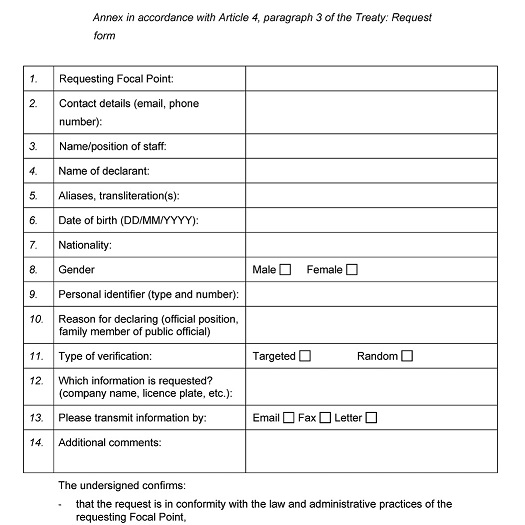
3. [Template] The Parties agree on a template for requests to be used by a requesting Party. The Focal Points can anytime agree bilaterally or multilaterally to change the template, which is annexed to the present Treaty.
4. [Obtaining information] The requested Focal Point shall use all relevant information gathering measures to provide the requesting Focal Point with the information requested.
5. [Promptness] The requested Focal Point shall forward the requested information as promptly as possible to the requesting Focal Point. To ensure a prompt response, the requested Focal Point shall confirm receipt of a request to the requesting Focal Point and shall notify the requesting Focal Point of deficiencies in the request.
6. [Feedback] If the requested Focal Point has been unable to obtain and provide the information within 30 days of receipt of the request, including if it encounters obstacles in furnishing the information, it shall immediately inform the requesting Focal Point, explaining the reason for its inability or the nature of the obstacles and until when it expects to furnish the information.
7. [Central record] RAI Secretariat facilitates that a central record of public registries available by each Party is established and regularly updated.
8. [Random verifications] Focal Points of two or more Parties may agree on a case-by-case basis to exchange information for the purpose of random verifications.
Article 5
Automatic exchange of information
Parties may establish mechanisms of automatic exchange of data. To this end, Focal Points may regulate separately issues of procedure and technical details, including information security.
Article 6
1. [Grounds] The requested Focal Point can decline to obtain or provide information;
a. [Domestic legality] which the requesting Focal Point would not be able to obtain under its own laws for purposes of verifying its own asset declarations;
b. [Legality] if the request is not made in conformity with this Treaty;
c. [Ordre public] if the requested Focal Point considers the disclosure of the information to be contrary to the ordre public or other essential interests of the Party having established it;
d. [Quantity] if the requested Focal Point considers that the overall amount of requests received by it from Focal Points in the past twelve months exceeds the number it can reasonably administer;
e. [Impossibility] if it is de facto impossible for the requested Focal Point to obtain the data (Article 4 paragraph 6).
2. [Feedback] If a Focal Point decides to decline a request in accordance with paragraph 1 of this article, it shall immediately inform the requesting Focal Point, explaining the reason for its decision.
Article 7
1. [Online databases] Authorities of one Party may research and use information available online to anybody in public or private registries available in the territory of another Party if the authorities use this kind of information under their domestic law for verifying asset declarations. Article 9 does not apply to data obtained by these means.
2. [Central record; language] RAI Secretariat facilitates that a central record of freely available online databases by Parties is established and regularly updated. If such databases do not provide of an English language interface, Parties may provide each other support through measures such as translated interfaces.
3. [Databases with limited access] If information in state registries is available online to any citizen of one Party under certain restrictions (such as registration requirements, access fees, or usage limitations), that Party can provide other Parties direct access to these databases. Parties shall consider concluding bilateral arrangements, such us memoranda of understanding, to regulate further details.
4. [Access to declarations] In order to facilitate the foreign use of asset declarations, each Party shall consider strengthening efforts to make data from the declarations it holds freely available online to the extent the public has the right to access it. Each Party shall also consider strengthening efforts to establish online databases allowing users to access the declarations through an English language interface in addition to the official language or languages of the Party.
Article 8
Spontaneous exchange of information
One Focal Point may without prior request transmit to another Focal Point information that has come to the attention of the first-mentioned Focal Point and that this first-mentioned Focal Point considers foreseeably relevant to the accomplishment of the purpose of the Treaty referred to in Article 1. The Focal Points may determine on a case-by-case basis the procedures to be used to exchange such information.
Article 9
1. [Data protection] Any information obtained by a Focal Point shall be treated as confidential and protected in the same manner as information obtained under the domestic law of the respective Party and, to the extent needed to ensure the necessary level of protection of personal data, in accordance with the safeguards which may be specified by the supplying Focal Point as required under its domestic law.
2. [Circle of disclosure] Such information shall in any case be disclosed only to persons or authorities (including courts and administrative or supervisory bodies) concerned with the verification of, the enforcement or prosecution in respect of, or the determination of appeals in relation to, the veracity of asset declarations of that Party, or the oversight of the above. Only the persons or authorities mentioned above may use the information and then only for such purposes. They may, notwithstanding the provisions of paragraph 1, disclose it in public civil or administrative court proceedings or in judicial decisions of civil or administrative courts relating to asset declarations.
3. [Open data] Paragraphs 1 and 2 do not apply to information obtained under Article 7.
Article 10
1. [Designation] For the exchange of information provided for in Chapter II, each Party shall designate a Focal Point, as defined in Article 2, lit. f. In particular, the Focal Point shall make and receive requests for information, and shall either provide the requested information or collect it from the competent domestic authorities.
2. [Regions] If a Party has a special region or territory with a separate system of verifying asset declarations, it may designate a distinct Focal Point having the same function as described in paragraph 1 for that region or territory.
3. [Statistics] Focal Points shall publish annual statistics on the requests made and received by them in their official language and in addition, to the extent possible, in English language.
4. [Domestic powers] Upon ratification, acceptance or approval of this Treaty by one Party, legal powers of its Focal Point and of the other authorities it cooperates with to obtain information for the verification of asset declarations of domestic declarants extend to information exchanged under this Treaty.
Article 11
Assistance granted under this Treaty is free of cost. Incidence of costs incurred in providing assistance in exceptional cases shall be agreed by the Focal Points involved prior to the exchange of data. National legislation of the Party of the requested Focal Point regarding the incidence of costs applies.
Article 12
Requests for assistance and answers thereto shall be drawn up in English, or any other language agreed upon bilaterally between the Focal Points involved, or in the language of the requested Focal Point.
FINAL PROVISIONS
Article 13
Other international agreements or arrangements; European Union law
1. This Treaty does not limit the exchange of information provided for in other international agreements or other arrangements being in force for the Parties.
2. Nothing in this Treaty shall be interpreted as restricting or adversely affecting the obligations of Parties to this Treaty arising from membership in the European Union.
Article 14
Signature, Ratification, Acceptance, Approval and Accession
1. This Treaty shall be open to all States for signature as of March 19, 2021.
2. This Treaty is subject to ratification, acceptance or approval. Instruments of ratification, acceptance or approval shall be deposited with the Government of the Republic of Serbia.
3. This Treaty is open for accession by any State or any territory able autonomously to accomplish the purpose of the Treaty as stated in Article 1. Instruments of accession shall be deposited with the Government of the Republic of Serbia.
4. The European Union may accede to this Treaty.
Article 15
Entry into force and Provisional Application
1. This Treaty shall enter into force thirty days after the date of the deposit of at least three instruments of ratification, acceptance or approval.
2. For each State or territory ratifying, accepting, approving or acceding to this Treaty after it entered into force in accordance with paragraph 1 of this article, the Treaty shall enter into force on the thirtieth day after the date of deposit of the relevant instrument. The same rule applies to an accession of the European Union to this Treaty.
3. Pending its entry into force, this Treaty may be applied provisionally by the States having signed it in accordance with Article 14, paragraph 1, and subject to a declaration made by a State upon signature.
4. Pending its entry into force for a State or territory acceding to this Treaty in accordance with Article 14, paragraph 3, this Treaty is applied provisionally between that State or territory and the Parties to the Treaty.
5. This Treaty shall apply to any ongoing verification of an asset declaration or any verification procedure started or reopened by a requesting Party after the Treaty entered into force for that Party, even if the declaration was submitted before that date.
6. This Treaty shall apply notwithstanding any changes in the asset declaration system of a Party taking place after the entry into force of the Treaty.
Article 16
1. After the expiry of three years from the entry into force of this Treaty, a Party may propose an amendment and transmit it to the depositary who shall thereupon communicate the proposed amendment to the Parties for the purpose of considering the proposal. If at least three Parties wish so, the depositary shall convene a meeting of the Parties to discuss and decide on the proposal. The meeting shall make every effort to achieve consensus on each amendment. If all efforts have been exhausted, an amendment shall require for its adoption a two-thirds majority vote of the Parties present and voting.
2. An amendment adopted in accordance with paragraph 1 of this article is subject to ratification, acceptance or approval by the Parties.
3. An amendment shall enter into force in respect of a Party thirty days after the date of the deposit with the depositary of an instrument of ratification, acceptance or approval of such amendment by that Party.
4. A Party which does not ratify, accept or approve an amendment remains to be bound by the provisions of this Treaty and any earlier amendment that it has ratified, accepted or approved.
Article 17
1. A Party may denounce this Treaty by written notification to the depositary. Such denunciation shall become effective six months after the date of receipt of the notification by the depositary.
2. Any Party which has denounced this Treaty shall remain bound by the provisions of Article 9 (Confidentiality).
Article 18
1. The original of this Treaty, which is drawn up in English language, shall be deposited with the Government of the Republic of Serbia who shall transmit certified copies of the Treaty to all Parties.
2. The Government of the Republic of Serbia is designated depositary of this Treaty.
3. The depositary shall notify all Parties of:
(a) the deposit of any instrument of ratification, acceptance or approval of, or accession to, this Treaty;
(b) an amendment adopted in accordance with Article 16;
(c) the date at which the Treaty enters into force for a State or a territory whichhas expressed its consent to be bound by the Treaty, or for the European Union;
(d) any notification by which a Party denounces this Treaty in accordance with Article 17;
(e) any other act or notification of a Party relating to this Treaty.
4. At the request of a Party, the depositary may convene a meeting of the Parties, to discuss matters related to the interpretation or implementation of the Treaty.
Signed on March 19, 2021, in Belgrade
In witness whereof, the undersigned being duly authorised by their respective Governments, have signed this Treaty
Mr. Vladimir Leposavić |
|
Minister of Justice, Human and Minority Rights |
|
The Government of Montenegro |
_________________ |
|
|
Ms. Biljana Ivanovska |
|
President of the State Commission for |
|
Prevention of Corruption, the Republic of |
|
North Macedonia |
_________________ |
|
|
Ms. Maja Popović |
|
Minister of Justice |
|
The Government of the Republic of Serbia |
_________________ |
Annex in accordance with Article 4, paragraph 3 of the Treaty: